ROSI soundproofing Natural insulation materials from the Waldheimat
Effective insulation with wood only?
Combating noise at its source is the most effective form of soundproofing - whether by minimizing the generation, transmission or radiation of sound. Where this is not possible, the only remaining option is to encapsulate the source.
This is where our booths come into play. The high sound insulation effectiveness of STUDIOBOX has been proven for decades and is widely known. However, since more and more people long for peace and quiet in a natural environment, and since the better is famously the enemy of the good, we wanted answers to these previously unanswered questions:
- Does soundproofing - with wood only - work at the same high level?
- How biological and sustainable can noise protection actually be?
International research project
To find out, we had to enter new territory. But not only we. The best experts in the fields of soundproofing, room acoustics and acoustic architecture, whom we were able to win for an international research project, were also faced with unexplored topics such as:
Which types of wood and wood-based materials are the best? How do material density, material thickness and surface finish relate to each other? How must the booth be constructed? What about all the other, general factors influencing sound insulation?
Insulation values far above the ISO standard
Today we know that it works. ROSI is not only the world's first noise protection booth built solely from solid wood and wood-based materials, but also has the same high sound insulation values as its "sister booths": down to minus 53 dB.
And not only that: in some frequency ranges, the results are even slightly better. The measured values were all produced and verified by the Fraunhofer Institute for Building Physics.
According to the new Europe-wide standard ISO 23351-1:2020, speech level reduction for soundproof booths & co. is divided into five classes. The highest, A+, prescribes a reduction of at least 33 decibels/dB. Classes A, B, C and D are correspondingly lower.
Privacy is maintained
Even if manufacturers, especially of glass acoustic booths, claim otherwise: privacy/data protection is only guaranteed to a limited extent even at -33 decibels. Much still gets through and remains clearly understandable. Too much. Especially since most booths only rank in classes A and B.
ROSI exceeds class A+ by up to 20 decibels/dB.
For comparison:
Although the perception of loudness is subjective and also depends on hearing ability, it is said that with a reduction of 10 decibels/dB we perceive a sound source as roughly half as loud as before. With another 10 decibels less, it is halved again, amounting to only a quarter of the original loudness, etc.
Booth construction
Double-shell element structure + interior acoustics
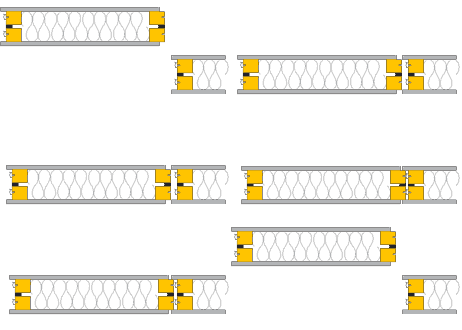
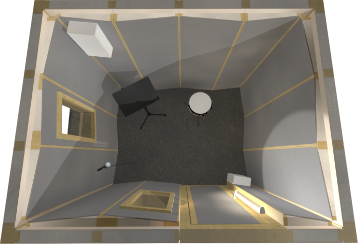
Every ROSI acoustic element has a double-shell structure. The outer and inner shells are connected by decoupled frames. Once the booth is assembled, tongue & groove as well as double seals in the joints ensure maximum tightness.
The elements are joined together using toggle latches. However, we can also build your dream booth with largely "invisible" metal latches. More details on request.
Doors and windows
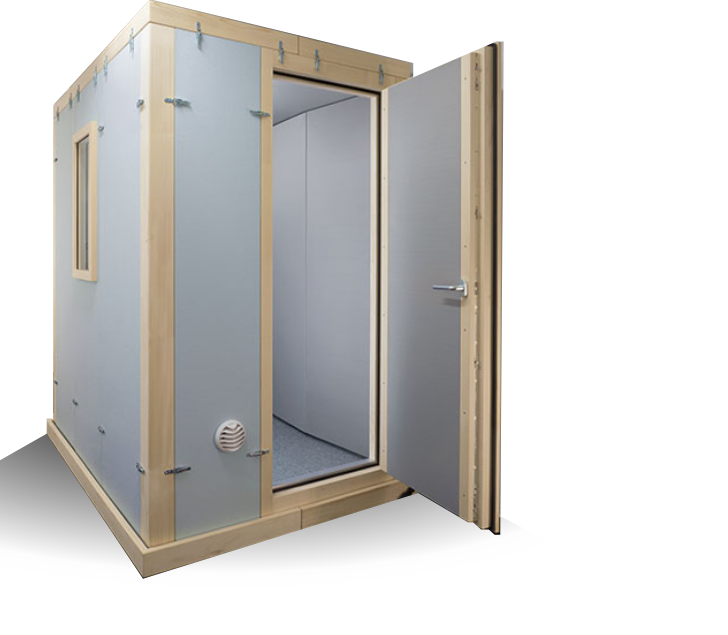
The door - an in-house development by STUDIOBOX - is matched to the modules. Double rebates with seals running all around and quadruple locking prevent unwanted sound transmission.
The windows are double-glazed with panes of different thicknesses and decoupled from the frame with cellular rubber strips. As a result, the quality of sound insulation - tested by the Fraunhofer Institute - is just as high for glass modules as for solid wall elements.
ROSI = STUDIOBOX quality features
- Double-shell wall element
- Floor construction, floating support
- Acoustic door (in-house development)
- Long sound path thanks to effective element connections
- Soundproofed ventilation system
Factors influencing sound insulation
The most important questions in building acoustics:
- How much sound is transmitted between the inside and outside of a building?
- How much between the individual rooms?
- How can soundproofing be optimized?
- What role do airborne sound and impact/structure-borne sound play?
Effective soundproofing always depends on:
1. Quality of the soundproof booth
What counts here is the choice of materials, the construction and the manufacturing quality:
- Mass per unit area (weight of the acoustic element)
- Dynamic stiffness of the materials used
- Element size, thickness and filling
- Combination of the materials with each other
- Construction of the individual element and its vibration behavior
- Connection technology
- Quality of workmanship
2. Nature of the sound source
The most important parameters here are (with low frequencies requiring more effort):
- Pitch (frequency)
- Level and impulses (peaks)
- Diversity of frequency ranges (e.g. with orchestral instruments)
3. Quality of the building
As a general rule: the more massive the existing single-shell wall, the less noise arrives on the other side.
Solutions in acoustics are always relative and not "absolute". Acoustic booths generally have a sound-insulating effect. And, even if some manufacturers claim otherwise:
The absolutely soundproof, modular booth does not exist.
Measuring the airborne sound insulation of a fully assembled booth
The airborne sound insulation between two rooms in a building is determined in accordance with DIN EN ISO 16283.
Your ROSI is either the source room or the receiving room - depending on the direction of measurement. What matters is: depending on the frequency, the airborne sound insulation can be converted into a single-number value Dn to characterize the acoustic performance.
To assess the quality of a booth correctly, however, the individual measured values of the different frequencies should always be considered as well. The single-number value has only limited significance for the sound insulation quality of the entire construction.
Measuring a single element in the laboratory
R and Rw are pure laboratory values representing the sound insulation quality of a component. Here, a single acoustic element is measured in the door test frame of the acoustics laboratory.
These parameters provide information about the quality of the individual element, but not about that of the fully assembled soundproof booth.
Get in touch with us
Do you have any questions or suggestions? Write to us, we look forward to your feedback!


